Thursday, February 18, 2010

Raise High the Roof Beam, Carpenters -and- Seymour, an Introduction

TITLE: Raise High the Roof Beam, Carpenters and Seymour, an Introduction

AUTHOR: J.D. Salinger

Like every other American child in the last 40 years, I was forced to read The Catcher in the Rye in High School. And though I enjoyed it (it was, in fact, one of the only books set upon me in High School that I enjoyed), the book does its part to distort the perception of Salinger’s work. His other three books are starkly different, but too many people have read nothing but that, and it is worth saying that of the few dozen fans of his published works that I’ve known or spoken to in my life, I can’t think of anyone who puts Catcher in the Rye in the top two.

I say all that to say this: if all you know about J.D. Salinger is the obligatory Holden Caufield in late-adolescence – whether you liked the book or not – there is so much more, and I’ll say better, to read.

Raise High the Roof Beam, Carpenters: Salinger has this inimitable gift for writing beautiful prose conversationally. It’s as if he’s recounting to you, an old friend, the details of an event for which he was actually present. Just telling you a story. It’s seemingly effortless without being pedestrian, and while you can read it ten times and get something new out of it each time, you’ll frequently look down to find, with surprise, you’ve already read 50 pages.

This story is told in first person from Buddy Glass of the Glass family, Salinger’s favorite characters. He writes about them with such frequency (this, Franny and Zooey, and several of the Nine Stories are all about the same characters, and the narrative voice is always of the second oldest, Buddy), and with such palpable affection, such detail, that it still offers me a small surprise to reflect that they are imaginary.

But in any event, this is a first person account of the eldest brother, Seymour’s, wedding. Seymour is the poet of the family, and Salinger saves all his best thoughts and musings for him. Seymour never shows up, stands up his bride-to-be, and the story is much about the aftermath. There’s so much I want to say about this and I won’t, not that the plot is all so important, but still. It's good enough that you deserve what minor suspense is available to you. I will say that it’s a wonderful story, and contains moments of stunning, pan-human empathy like I’ve never read in my life. While Franny and Zooey, taken together, is my favorite, this one is a close second.

Seymour, an Introduction: I can’t broadly dismiss this story. Some people like it. I do, however, feel confident in saying that if there wasn’t such a paucity of Salinger material, I would never read this story again. It’s the author, again as Buddy Glass, talking at great length about his brother Seymour. No plot, no real point, just a character description, with about 20,000 asides, parentheticals, tangents, and other onanistic indulgences. That conversational style that I so emphatically praised above? This is the one and only time in his writing where he takes it much too far.

It’s still worth reading, I suppose, but I’d save it for when there is no more of him to read. It’s got a few great quotes, very clever stuff, which, unlike above, I have no conscience whatsoever about replaying:

  • He mentions getting older: “whoever we are, no matter how like a blast furnace the heat from the candles on our latest birthday cake…”
  • He reprints his Seymour's opinions on one of his past stories: “I feel your censure on all [the character's]‘God-damns.’ That seems off to me. What is it but a low form of prayer when he or Les or anybody else God-damns everything. I can’t believe God recognizes any form of blasphemy. It’s a prissy word invented by the clergy.”

He’s very clever, and very smart, and knows how to write. This story just gets too post-modern, too many asides to the reader, too many references to himself writing the story. Too much for me, anyway. One needs to have a good deal of interest in this made-up Seymour Glass to muscle through it, but even with an interest (which I have), it’s still laborious.

If you’ve read everything else, then read this. If you haven’t, goto Step 1, and come back when you have. You’ll want to, by then.

Wednesday, February 17, 2010

Motherless Brooklyn by Jonathan Lethem


The story of Lionel Essrog, a detective suffering from Tourette's syndrome, as he tracks down the killer of his boss, Frank Minna. Minna enlisted Lionel and his friends when they were teenagers living at Saint Vincent's Home for Boys, ostensibly to perform odd jobs (we're talking very odd) and over the years trained them to become a team of investigators. The Minna men face their most daunting case when they find their mentor in a Dumpster bleeding from stab wounds delivered by an assailant whose identity he refuses to reveal--even while he's dying on the way to the hospital. As a mystery this is a big departure from Lethem's other books, but his brilliance with writing convincing dialogues and plots remains the same. Just don't "fuggetabout" this one!

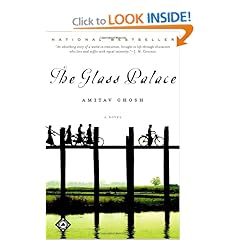
The Glass Palace by Amitov Ghosh


Set primarily in Burma, Malaya, and India, this work spans from 1885, when the British sent the King of Burma into exile, to the present. While it does offer brief glimpses into the history of the region, it is more the tale of a family and how historical events influenced real lives. As a young boy, Rajkumar, an Indian temporarily stranded in Mandalay, finds himself caught up in the British invasion that led to the exile of Burma's last king. In the chaos, he spies Dolly, a household maid in the royal palace, for whom he develops a consuming passion and whom years later he tracks down in India and marries. As their family grows and their lives intersect with others, the tangled web of local and international politics is brought to bear, changing lives as well as nations. Ghosh ranges from the condescension of the British colonialists to the repression of the current Myanmar (Burmese) regime. A compelling look into a region of the world long hidden and little known.

Under the Banner of Heaven by Jon Krakauer


The study of religious fanaticism told through the story of Ron and Dan Laferty, Mormon fundamentalist brothers who in 1984 murdered the wife and infant daughter of their youngest brother Allen. Claiming that they were instructed by God to carry out this horrific act, the brothers' interviews with the author are chilling and unremorseful. The book is a scary look into the minds of fundamentalists of all religions who believe that their actions-no matter how heinous-are indeed divine instructions.

Isaac's Storm by Erik Larson


Torqued by drama and taut with suspense, this absorbing narrative of the 1900 hurricane that inundated Galveston, Tex., conveys the sudden, cruel power of the deadliest natural disaster in American history. Told largely from the perspective of Isaac Cline, the senior U.S. Weather Bureau official in Galveston at the time, the story considers an era when "the hubris of men led them to believe they could disregard even nature itself."

The Bone People by Keri Hulme


A beautifully written, haunting story about a part-European, part Maori woman artist living alone on the New Zealand Sea. When a young Maori boy washes up onto shore, her life changes in unimaginable ways. As the New York Times book review reports, The Bone People is "masterfully written...a compelling blend of dream, myth, and harsh reality." I highly recommend it.

Sunday, February 14, 2010

Blankets


Title: Blankets
Author: Craig Thompson
Category: Autobiographical Comic/Graphic Novel
This is definitely the best autobiographical comic I've read in recent history. It is Thompson's journey through adolescence growing up in the Midwest and raised by fundamentalist Christian parents. His development as an artist throughout the story represents his attempts at complimenting the reality he encounters and the one his faith has taught him. Don't be frightened by how long it is. A good graphic novel is necessarily long and the character and story development in this one are just perfect. I'm sure the fact that I read this right around the same time I read Plato's Republic for the first time has significantly impacted my positive opinion of it, as it is Thompson's own Allegory of the Cave. And if you haven't read Plato's Republic yet, you should go ahead and pick that up as well. More than anything it is remarkably honest and sincere and beautifully articulated.

Saturday, February 13, 2010

Jurassic Park


Title: Jurassic Park Author: Michael Crichton. I had to put this one up. I feel like most people have read it but if not, do. One of my all-time favorites. I mean, who hasn't dreamed about being out in the jungle with dinosaurs? And even better, Crichton has the ability to justify it with modern science (techniques that actually are used to sequence and analyze "dino DNA"). And if you like Crichton, read Prey as well. Creeepy book. Cool science.

Everything is Illuminated


Title: Everything is Illuminated Author: Jonathan Safran Foer. Beautifully written book. A bit of a downer--it's about a an American Jew who travels to Ukraine to investigate his family's past during WWII--but an amazing story, and told in a very unique way. Definitely worth checking out!

Monday, February 8, 2010

Shantaram


Title: Shantaram
Author: Gregory David Roberts.
Although a novel, which usually implies a work of fiction, the story told is based on the author's experiences. Well written and captivating, you follow the narrator as he escapes from prison in Australia and flees to India. In India, he starts a free health-clinic in the slums, and becomes a member of the Bombay mafia. This story it truly inspiring. At the end of which you will no doubt be filled with an urge to go to India.


Friday, February 5, 2010

Jenny and the Jaws of Life


TITLE: Jenny and the Jaws of Life
AUTHOR: Jincy Willett
CATEGORY: Short Story / Fiction

It's oddly comforting for a young writer to hear a story like Jincy Willett's. Comforting or depressing, depending on how you define success. Here's this woman, who in 1987, at 40, published her first book of short stories, a blackly comic, deeply moving, utterly brilliant book. A collection so good that she might've called that writing thing mastered, and moved to take up stamp collecting. It was critically praised but never caught on (this happens sometimes) and went out of print, this incredible achievement doomed to obscurity. But as it happens, one of the people who did read it in the late 80s was David Sedaris, who more or less single handedly brought it back from the dead. It's a nice story, if you're interested.

The book was re-released in anticipation of her novel, which is when I came across it. Willett has an incredible command of the English language, and the ability to write things that are so sad and yet so funny at the same time. Sedaris, in the forward, calls it "the funniest book of stories I've ever read," but it's not funny the way his stories are. Not Ha-Ha funny (though it can be). It's not just dark humor, it's black humor, coal black, but in the depths of depression, patricide, rape, etc., she avoids the easy abstraction of maudlin hope and finds a shorter route to humor than you knew was there.

"Best of Betty" is her most conventionally funny, the slow unraveling of an advice columnist told exclusively in letters. "Julie in the Funhouse" is the first story, a man whose sister has been killed by her own children, a trip through siblings and relationships and the truth that by the time we realize what time is taking from us, it's already too late. "Under the Bed," a first person story of a woman who was raped, and feels as though she's the only one dealing with it logically. "The Haunting of the Lindguards," a story, both painful and hilarious, of an apparent hairline fracture in a relationship turning out to be a fault line.

It goes on and on. It's hard not to love her protagonists. Because of their faults as much as despite them. She writes women particularly well, and through her considerable control of language, can create not just a character's tics, or speaking style, or desires, but their whole inner world. It's remarkable.

It sags a little bit in the middle, I think, with "Father of Invention" and "My Father at the Wheel," but it comes back with "Anticipatory Grief" and grips you until the end. They're the type of stories that you can't really read one after another, you finish one and you need to put it down for a while, think about it, mull over it. Days, these things stay with you. I haven't read the book in a year, and I am still visited by "Resume" or "Under the Bed" or "The Jaws of Life." It's that good.

So yes. Read this book.